
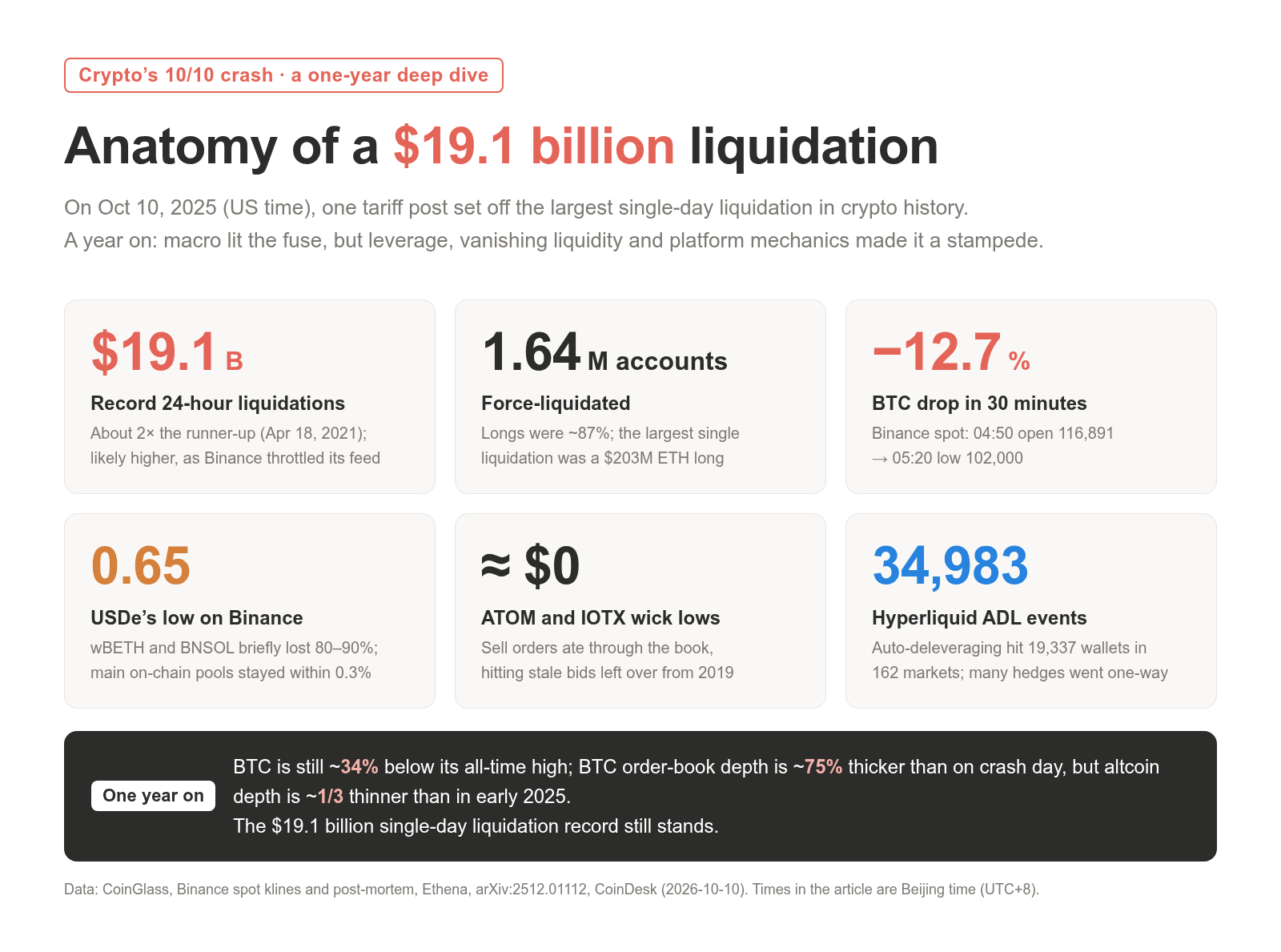
At 04:50 Beijing time on October 11, 2025 (20:50 UTC on Friday, October 10), Donald Trump announced on Truth Social a 100% tariff on Chinese goods starting November 1[1]. Within 30 minutes, bitcoin fell from $116,891 to $102,000 on Binance, most altcoins lost half their value intraday, and ATOM briefly traded at $0.001. Over 24 hours, more than 1.6 million accounts were force-liquidated and more than $19 billion in positions were wiped out, roughly twice the previous record. A year later, that record still stands[2][3].
For the first anniversary, we combined Binance one-minute klines, exchange post-mortems, academic research and industry reports to break that night into four layers (trigger, fuel, vacuum and amplifiers), and to see which holes have been patched a year later and which are still open.
(Chinese-speaking communities call the event "10·11" after its Beijing date; English-language coverage calls it "10/10" after the UTC date. Unless noted otherwise, all times below are Beijing time, UTC+8.)
Key takeaways
- Tariffs lit the fuse, but the scale was structural. The Nasdaq fell 3.6% that day[4], yet crypto liquidations came to about twice the previous record. Three things determined the damage: leverage stretched to the limit, liquidity that vanished in an instant, and flaws in platform mechanics.
- Mispricing caused a "second wave" of liquidations. Binance's Unified Account valued USDe, wBETH and BNSOL off its own spot order books. When those books broke, USDe was marked at $0.65, and wBETH and BNSOL briefly at just 10%–20% of fair value, dragging down many positions that would otherwise have survived[5].
- One asset, two prices. At the same moment, USDe deviated no more than 0.3% in the main on-chain pools, and minting and redemptions never stopped. The problem was the exchange's valuation, not the asset itself[6][7].
- The on-chain venue held up, but the winners paid. Hyperliquid absorbed about $10.3 billion in liquidations without bad debt, but it triggered its first cross-margin auto-deleveraging (ADL) in more than two years, cutting many traders' hedges and leaving them with one-sided exposure[2][8].
- One year on, majors have recovered; altcoins have not. BTC order-book depth is about 75% thicker than on crash day, even though the price is about 34% below its all-time high. Altcoin depth, by contrast, is about a third thinner than in early 2025[9].
1. Scale: one night that rewrote the record books
| Metric | Figure |
|---|---|
| 24-hour liquidations | ~$19.1 billion[10][2] |
| Accounts liquidated | ~1.64–1.66 million (different snapshots)[11][2] |
| Long/short split | Longs ~$16.7 billion, shorts ~$2.5 billion[2] |
| Largest single liquidation | A ~$203 million ETH long on Hyperliquid[2] |
| The most concentrated 40 minutes | ~$6.93 billion liquidated from 04:50 to 05:30, about 70% of Amberdata's daily total; one-minute peak of ~$3.21 billion at 05:15[2] |
| Market value lost | ~$350–500 billion of total crypto market cap (depending on the measure)[2][12] |
| Open interest | ~$19 billion erased within 36 hours[13] |
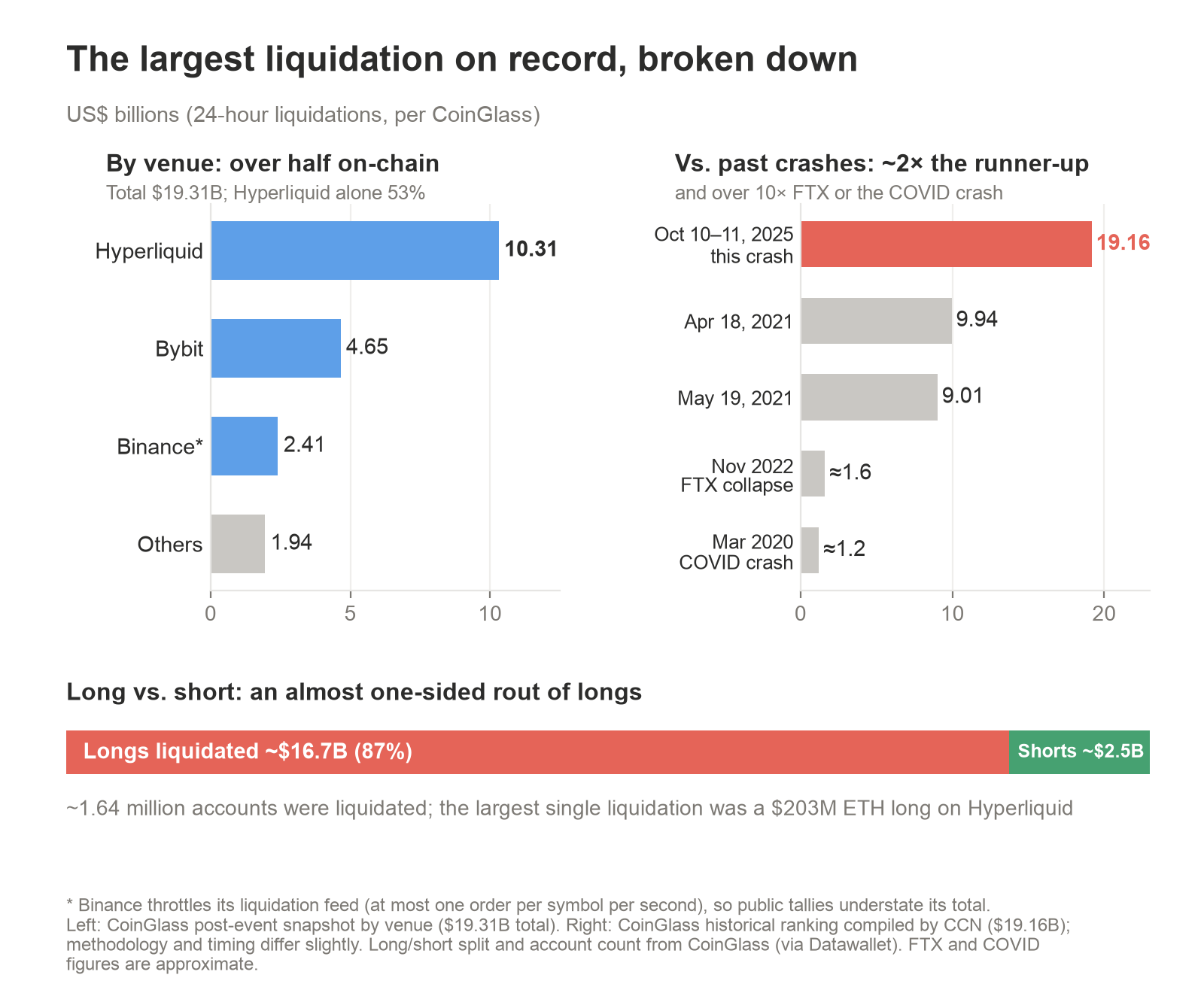
- A break with history: The previous single-day record was about $9.94 billion on April 18, 2021. The FTX collapse and the March 2020 COVID crash ("312") saw only about $1.6 billion and $1.2 billion respectively[3][14].
- The main battlefield was on-chain: According to CoinGlass, Hyperliquid accounted for ~$10.31 billion, Bybit ~$4.65 billion and Binance ~$2.41 billion[14]. But Binance's liquidation feed reports at most one liquidation per second per trading pair, so its $2.41 billion is only a "sample"; the real figure is widely believed to be much higher[10][2].
- One-sided positioning: About 87% of liquidations were longs. Four days earlier (October 6), BTC had set an all-time high of about $126,200, and sentiment and positioning were crowded on the same side[2].
2. Timeline: from rare-earth controls to $0.001
| Beijing time | UTC | Event |
|---|---|---|
| 10/9 | — | China's Ministry of Commerce issues new rare-earth export controls (2025 Announcements No. 61 and 62) |
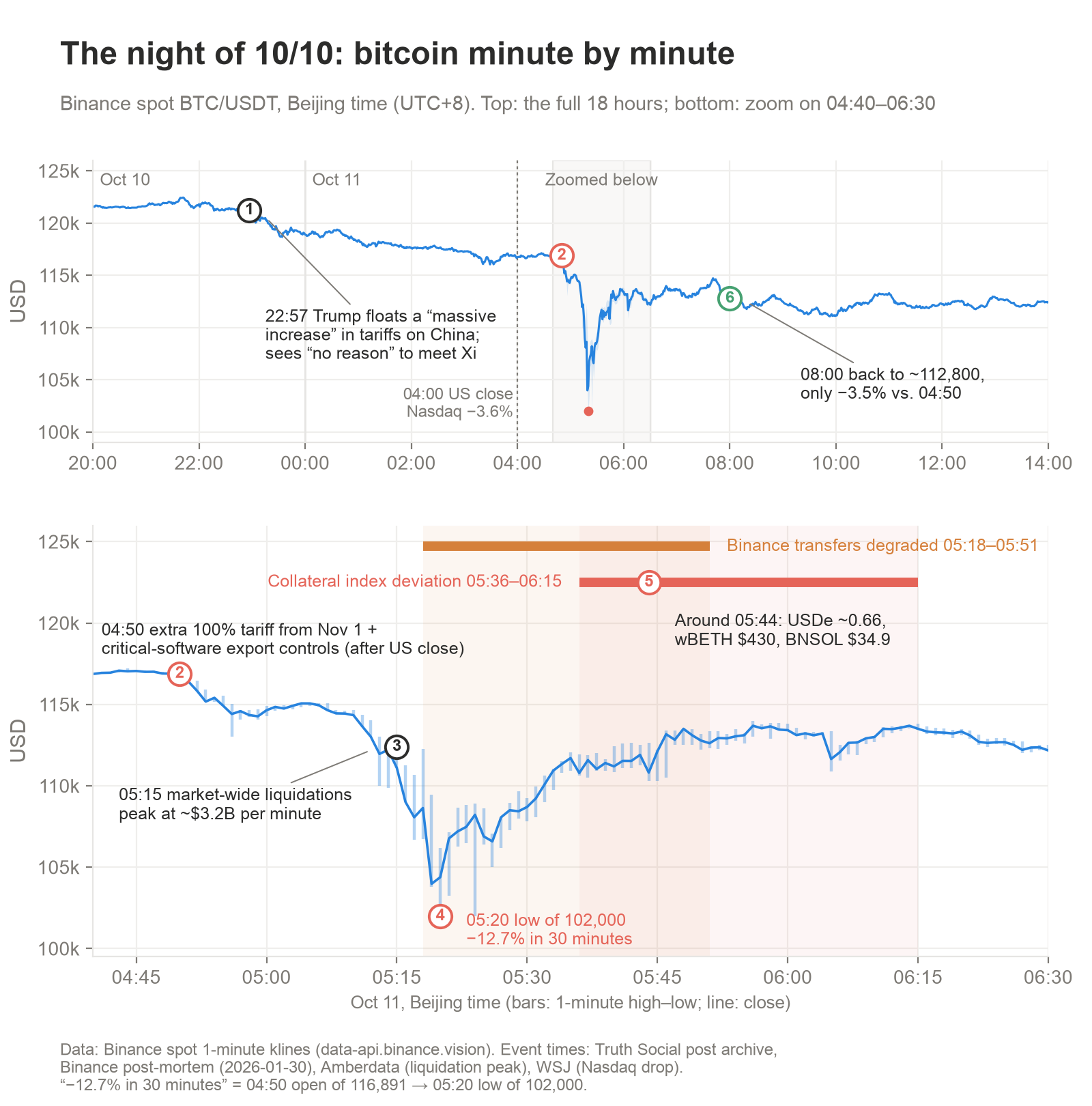
| 10/10 22:57 | 14:57 | Trump's first post: hostile in tone, says he is considering a "massive increase" in tariffs on China and sees "no reason" to meet Xi Jinping |
| 10/11 04:00 | 20:00 | US close: the Nasdaq falls 3.6% and the S&P 500 has its worst day since April |
| 04:50 | 20:50 | Second post: a 100% tariff on China from November 1, plus export controls on "any and all critical software" |
| 05:10–05:20 | 21:10–21:20 | The most volatile 10 minutes; liquidation speed peaks at 05:15 |
| 05:18–05:51 | 21:18–21:51 | Binance's asset-transfer subsystem is degraded for about 33 minutes; some users see their balances displayed as "0" |
| 05:19 | 21:19 | A single one-minute BTC candle falls 4.3% (108,635 → 103,975) |
| 05:20 | 21:20 | BTC hits 102,000; ATOM trades at 0.001 and IOTX at 0.000001 |
| 05:36–06:15 | 21:36–22:15 | USDe, wBETH and BNSOL depeg one after another on Binance |
| 08:00 | 00:00 | BTC is back at about 112,800 (−3.5% vs. 04:50); altcoins are still broadly down 14%–30% |
| Oct 12 (Sunday in the US) | — | Trump softens his tone: "Don't worry about China" |
| 10/30 | — | The Trump–Xi meeting in Busan yields a truce: US tariffs on China are cut from ~57% to ~47%, and China suspends the export controls announced on October 9 for one year |
Sources:[1][15][4][16][5][2][17][18][19]; prices from Binance spot klines.
Two details that are easy to miss:
- The first post did not crash the market. When it went out, US stocks were still trading, and BTC slid in an orderly way from about $121,200 to about $116,900 (−3.6%), in step with equities. The fatal blow was the second post. It landed 50 minutes after the US close on a Friday night: traditional markets were shut and the weekend was ahead, so 24/7 crypto was almost the only market still open for selling, and global risk-off pressure had a single exit to squeeze through.
- The liquidation engines, not the news itself, broke the price. In the first 20 minutes after the 100% tariff post (04:50–05:10), BTC fell only 2.2% (116,891 → 114,340). Over the next 10 minutes (05:10–05:20), it fell 10.8%. Binance's post-mortem also identifies 05:10–05:20 as the most volatile window[5]. Once the news had been absorbed, cascading liquidations took over the price.
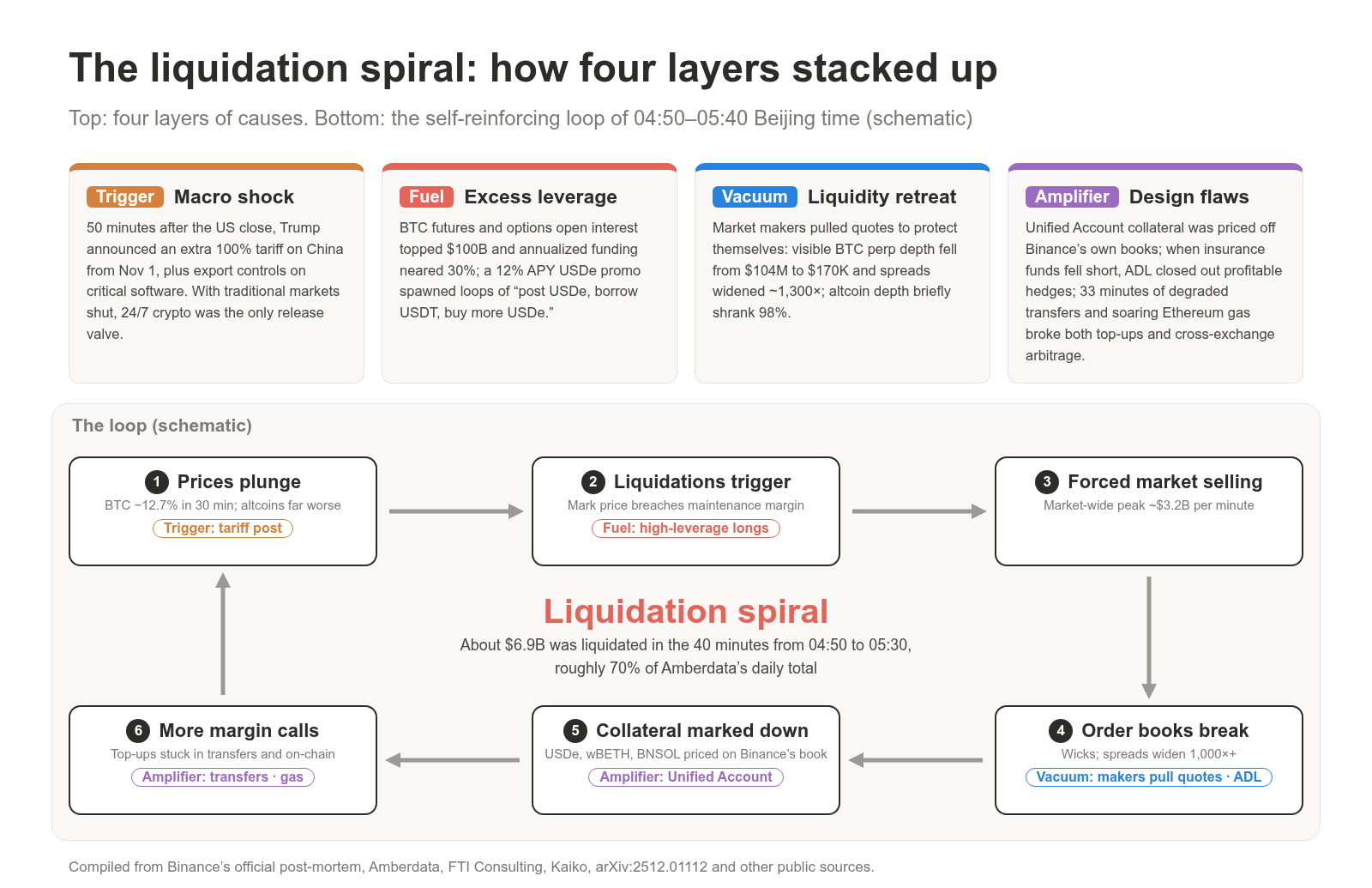
3. Breakdown: how four layers stacked into a stampede
3.1 The trigger: rare earths and tariffs
On October 9, China's Ministry of Commerce issued new rare-earth export controls. The next day Trump fired off two posts in response, escalating from a "massive increase" in tariffs to "a 100% tariff plus export controls on critical software"[15][1]. US stocks lost about $1.5 trillion in market value that day[5].
Macro shocks are not rare in themselves. What was rare was the timing, which was close to the worst possible moment:
- US markets had just closed, so traditional markets could not share the selling pressure;
- It was late Friday night, early Saturday morning in Asia, when trading desks are at their thinnest;
- BTC had hit an all-time high just four days earlier, so sentiment was at its most optimistic and positioning at its most crowded.
3.2 The fuel: record leverage
- In early October, open interest in BTC futures and options exceeded $100 billion[5];
- Perpetual funding rates climbed from about 10% annualized to nearly 30% by October 6, meaning longs were paying dearly to hold crowded positions[20];
- About 87% of the night's liquidations were longs[2];
- Looping with a yield-bearing stablecoin. In January 2026, OKX founder Star Xu argued that Binance had been offering about 12% annualized promotional yield on USDe while letting USDe serve as margin just like USDT and USDC. Users could post USDe, borrow USDT, swap it back into USDe and post that again, looping their yield up to 24%, 36% or even more than 70%[21]. Such positions are extremely sensitive to collateral prices: once USDe's price on the exchange slips, the whole leverage chain breaks at once.
3.3 The vacuum: market makers retreat en masse
- Binance's post-mortem, citing Kaiko data: at the worst moment, apart from Binance, Crypto.com and Kraken, major exchanges had almost no bids within 4% of the price[5];
- Amberdata: the BTC perpetual bid-ask spread widened from 0.02 basis points to 26.43 basis points (about 1,321×), and visible order-book depth shrank from about $103.6 million to about $170,000[2];
- FTI Consulting: top-of-book depth on major exchanges fell by more than 90%[20];
- For a major token on Binance tracked by Coinwatch, 1% two-sided depth fell from about $1.2 million to about $27,000 at 05:20 (−98%). Market makers only began to return after the most violent selling had ended, and depth on major CEXs took about 35 minutes to recover to more than 90% of pre-event levels[22].
There is nothing mysterious about market makers pulling their quotes. In extreme conditions inventory risk soars, cross-exchange hedging and fund transfers get stuck, and hedge legs can be forcibly closed by ADL. The rational move is to step back first and return once prices stabilize. As for the rumor that Wintermute was suing Binance, its CEO Evgeny Gaevoy has publicly denied it[23].
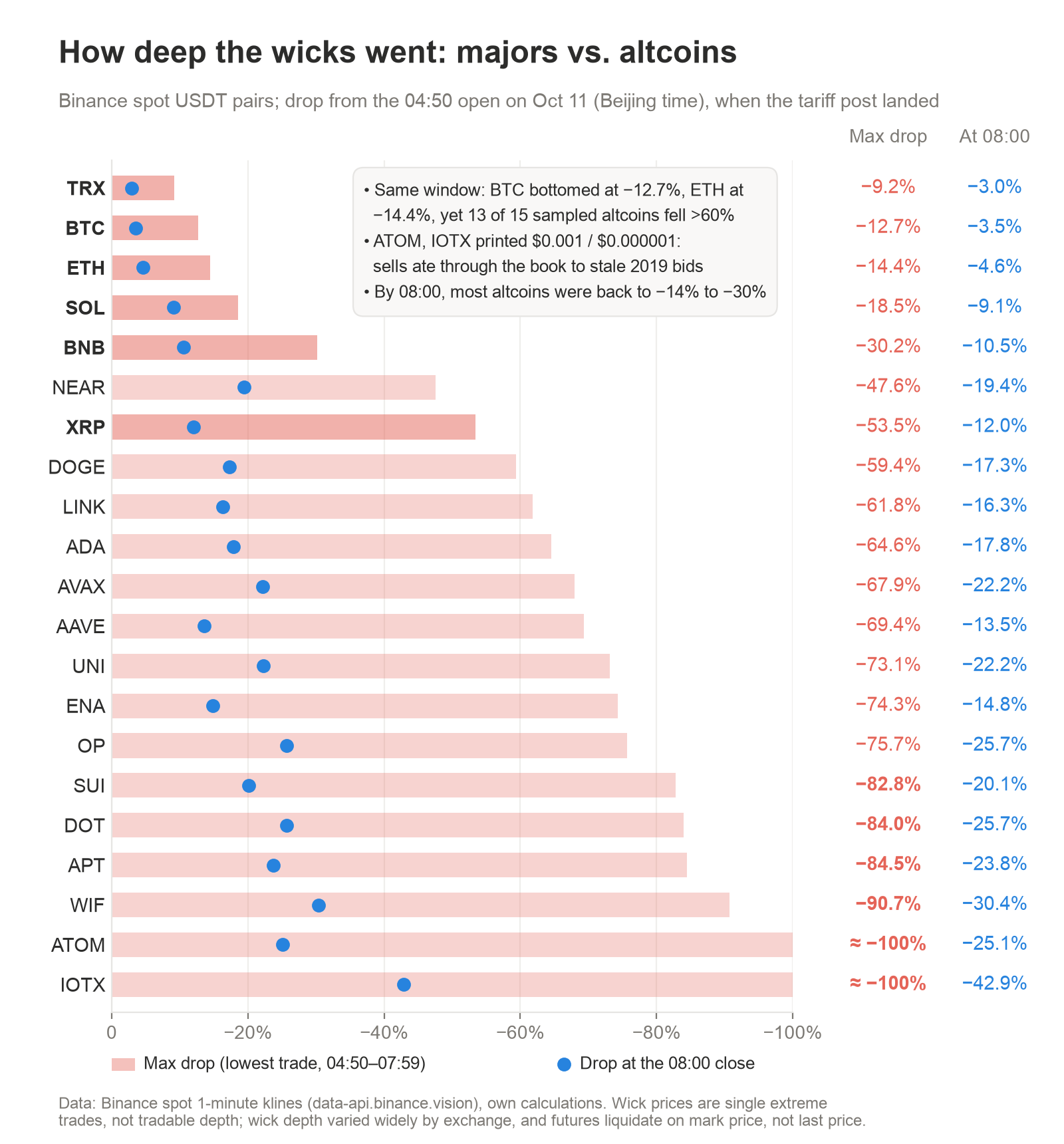
We measured the lowest traded price after 04:50 for 21 major coins on Binance spot. BTC fell at most 12.7% and ETH 14.4%, while 13 of the 15 altcoins in the sample fell more than 60% intraday, with WIF down as much as 90.7%. ATOM and IOTX printed near-zero prices because sell orders ate through the entire order book and were matched against ultra-low "legacy bids" that had been sitting there since 2019[5].
These wicks were liquidity events, not a repricing of value: by 08:00, most of the 15 altcoins had narrowed their losses versus 04:50 to 14%–30%. But the damage was done. Futures liquidations are calculated on a mark price (a multi-source index), which partly filters out wicks on any single exchange. Spot stop-loss orders, spot margin and assets used as collateral, however, were exposed directly to traded prices[5].
3.4 Amplifier #1: the Unified Account's "own order book" pricing
This was the most controversial part of 10/10, and also the most avoidable.
Binance's Unified Account let users post USDe, wBETH, BNSOL and similar assets as margin, but at the time these assets were valued mainly off Binance's own spot order books rather than their redemption or conversion value[5]. Once those books were broken:
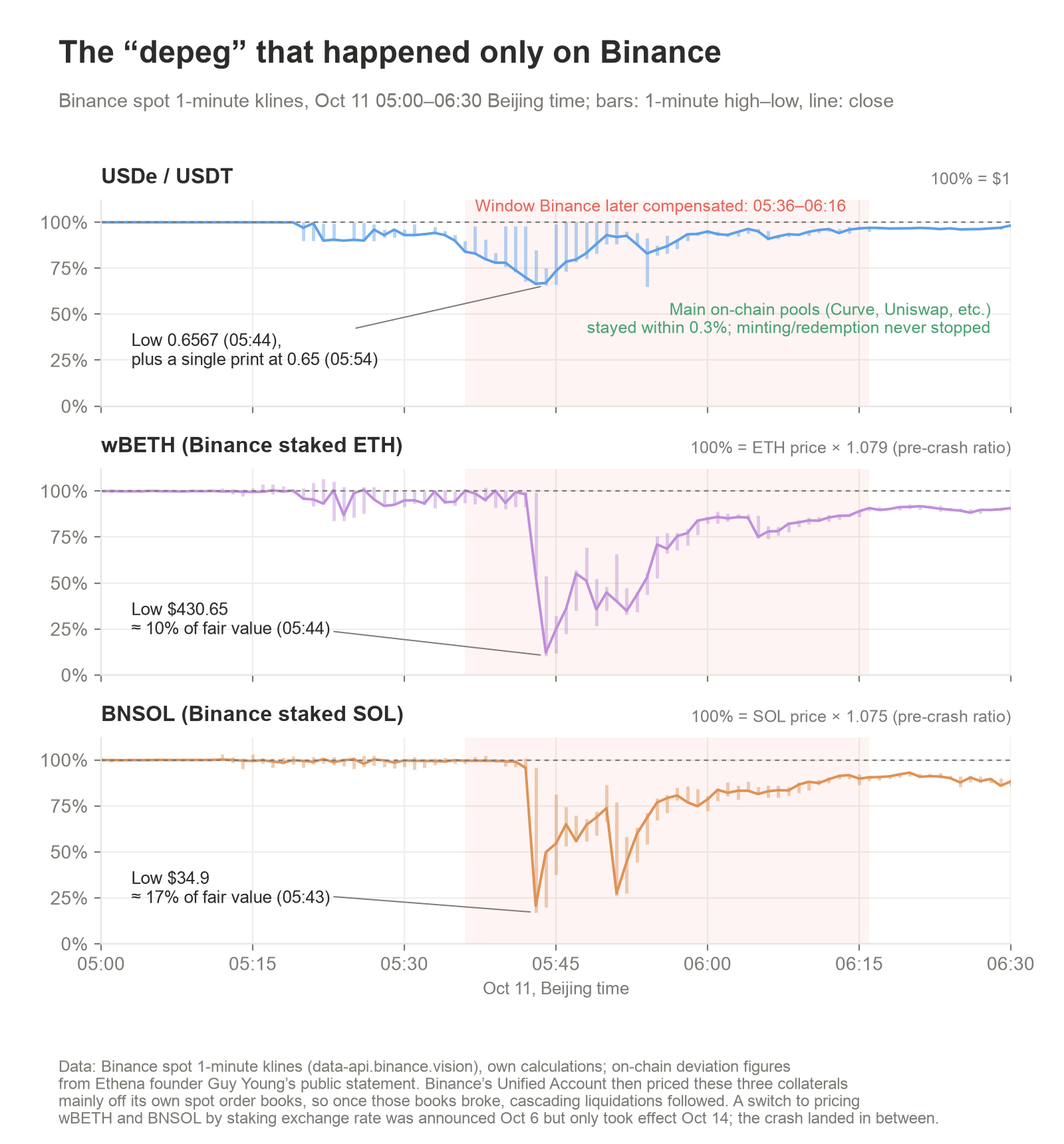
- USDe: fell to about 0.90 around 05:20, broke below 0.84 at 05:36, hit a low of 0.6567 at 05:44, printed a single trade at 0.65 at 05:54, and only recovered to about 0.97 by 06:16;
- wBETH: traded at $430.65 at 05:44, about 10% of fair value;
- BNSOL: traded at $34.9 at 05:43, about 17% of fair value.
Meanwhile, on-chain USDe carried on as normal. Ethena's minting and redemptions had zero downtime, about $2 billion in redemptions were processed within 24 hours, and on-chain pools such as Curve, Fluid and Uniswap deviated no more than 0.3%[6][7]. The same asset was marked down by 35% inside Binance while trading almost at par on-chain. That is the cost of pricing collateral off your own order book.
More ironic still, Binance had announced on October 6 that wBETH, BNSOL and other Unified Account collateral would switch to conversion-ratio pricing, effective October 14. It was three days too late[24].
Binance stresses that about 75% of the day's liquidations happened before the depeg began at 05:36[5], but it still paid about $283 million in compensation to users affected by these three assets between 05:36 and 06:16[25].
3.5 Amplifier #2: ADL turned hedges into naked bets
ADL (auto-deleveraging) is an exchange's last line of defense. When liquidated positions cannot be sold in the market and the insurance fund cannot cover the shortfall, the system forcibly closes the most profitable, most leveraged positions on the other side to fill the gap.
- Unprecedented scale: Hyperliquid triggered cross-margin ADL for the first time in more than two years[8]. An academic study counted 34,983 ADL executions on Hyperliquid that night, across 19,337 wallets and 162 markets. By its estimate, ADL cut about $653 million more in positions than the deficits that actually materialized[26][2].
- Only the winning leg gets cut: Take a hedged portfolio that is long BTC and short altcoins. Once the profitable short leg is closed by ADL, only the long is left, exposed in a crash: a neutral strategy has involuntarily become a one-way bet[27]. Some analysts dubbed this the "ADL death spiral." By contrast, BitMEX, backed by an ample insurance fund, applied ADL to just 15 contracts during the entire event[22].
- No bad debt for the platform, heavy losses for users: On Hyperliquid, more than 1,000 wallets were wiped out and 205 wallets lost more than $1 million each, yet the platform stayed online throughout and took no bad debt[2]. Its market-making vault, HLP, actually made about $41.5 million that weekend, a return of about 10% for depositors[28]. Co-founder Jeff Yan later posted an explanation of the ADL trigger logic[29].
3.6 Amplifier #3: infrastructure failed at the peak
- From 05:18 to 05:51, Binance's asset-transfer subsystem was degraded for about 33 minutes because of database hot-path and cache issues. Some users saw their balances displayed as "0" and could not top up margin in time[5];
- Redemptions from some Earn products were delayed, and Binance later compensated affected users[30];
- Ethereum gas briefly exceeded 100 gwei, sending the cost and time of on-chain top-ups and cross-exchange transfers soaring[5];
- Information failed too: the liquidation-feed throttling mentioned above left the market unable to see the true scale of liquidations exactly when it needed that information most[2].
4. The controversy: a Rashomon
4.1 Binance: admits localized problems, denies "causing the crash"
- Official position: the core matching engine worked normally throughout; the problems were concentrated in fund-transfer delays and the price deviations of USDe, BNSOL and wBETH[30].
- Compensation: Binance first paid about $283 million to users affected by the depeg[25], bringing the cumulative total to more than $328 million by October 22[5].
- The $400 million "Together Initiative": $300 million in USDC vouchers went to users who were liquidated in Binance futures or margin trading on October 10–11 (UTC), lost at least $50, and whose losses equaled 30% or more of their net assets in the October 9 snapshot. Amounts ranged from $4 to $6,000 per user. Another $100 million in low-interest loans supports institutions and ecosystem partners[31].
- Insurance fund and post-mortem: That night Binance drew about $188 million from its insurance fund to cover bad debt[32]. On January 30, 2026, it published a full post-mortem[5].
4.2 Star Xu vs. Binance
In late January 2026, OKX founder Star Xu published a long post arguing that Binance's high-yield USDe promotion and collateral rules had created systemic leverage and were a key reason 10/10 was amplified[21]. Binance co-CEO Richard Teng, speaking in February 2026, instead pointed to Trump's tariff announcement and stressed that Binance was not the only venue to see massive liquidations that night[32].
Our view:each side is only half right. About 75% of liquidations happened before the depeg, which shows that the bulk of the crash came from a macro shock compounded by market-wide leverage; it cannot all be pinned on Binance. But the 05:36–06:16 depeg was a highly concentrated and avoidable point of failure. Unified Account users who had survived the first wave were then "stabbed in the back" by their own collateral in the second.
4.3 Suspicions of insider trading
- Less than an hour before the 100% tariff post, a whale address on Hyperliquid opened a BTC short of about $735 million[17]. Its BTC and ETH shorts together exceeded $1.1 billion and went on to make about $150–160 million in profit[33].
- On-chain sleuths linked the address to former BitForex CEO Garrett Jin, and Changpeng Zhao (CZ) reposted the claims. Jin denied insider trading, saying the wallet belonged to a client[17].
- Crypto.com CEO Kris Marszalek publicly called on regulators to investigate the exchanges with the largest liquidation losses[34].
- So far, none of these allegations has been resolved.
4.4 CeFi vs. DeFi: who held up better?
| Platform | That night | Problems exposed | Outcome |
|---|---|---|---|
| Binance | Core matching worked; ~$2.4 billion liquidated (feed-based, clearly understated) | Collateral priced off its own book, transfer delays, opaque liquidation data | Over $328 million in compensation, plus the $400 million Together Initiative |
| Hyperliquid | ~$10.3 billion liquidated; online throughout | First cross-margin ADL in more than two years; hedges cut | No bad debt; HLP earned ~$41.5 million |
| Aave | ~$180 million of collateral liquidated automatically within about an hour | Governance token AAVE briefly fell 64% intraday | Liquidations fully automated, with no manual intervention |
| Ethena | Minting and redemptions never stopped; ~$2 billion redeemed in 24 hours | A severe gap between the exchange (Binance) price and on-chain prices | On-chain deviation of no more than 0.3% |
That night did not prove that DeFi is always safer than CeFi. What really passed the test were mechanisms whose pricing and rules were transparent and predictable enough, whether they ran on-chain or off.
5. Aftershocks and one year later
5.1 A one-year timeline
- 2025/10/12–10/30: Trump softened his stance ("Don't worry about China"), and the US and China then reached a truce in Busan[17][18][19].
- 2025/11/3–4: DeFi yield platform Stream Finance disclosed a loss of about $93 million caused by an external fund manager and suspended deposits and withdrawals; its yield-bearing stablecoin xUSD promptly depegged badly[36]. Through rehypothecation and oracles hardcoded at $1, the shock spread to three stablecoins (xUSD, deUSD and USDX) and involved about $285 million[37].
- 2025/11/21: BTC fell below $81,000 intraday (low of 80,600).
- 2026/1/31: Garrett Jin's leveraged ETH long was liquidated on Hyperliquid, earning HLP another ~$15 million[28]; around the same time, Star Xu published his broadside against Binance[21].
- 2026/2/6: BTC fell to $60,000 intraday.
- 2026/7/1: BTC fell to $57,800 intraday, about 54% below its all-time high, the lowest point of this cycle so far.
- 2026/8/20: A sharp rally caught traders who had held shorts since October, liquidating about $2.7 billion in short positions, the largest short liquidation on record[2].
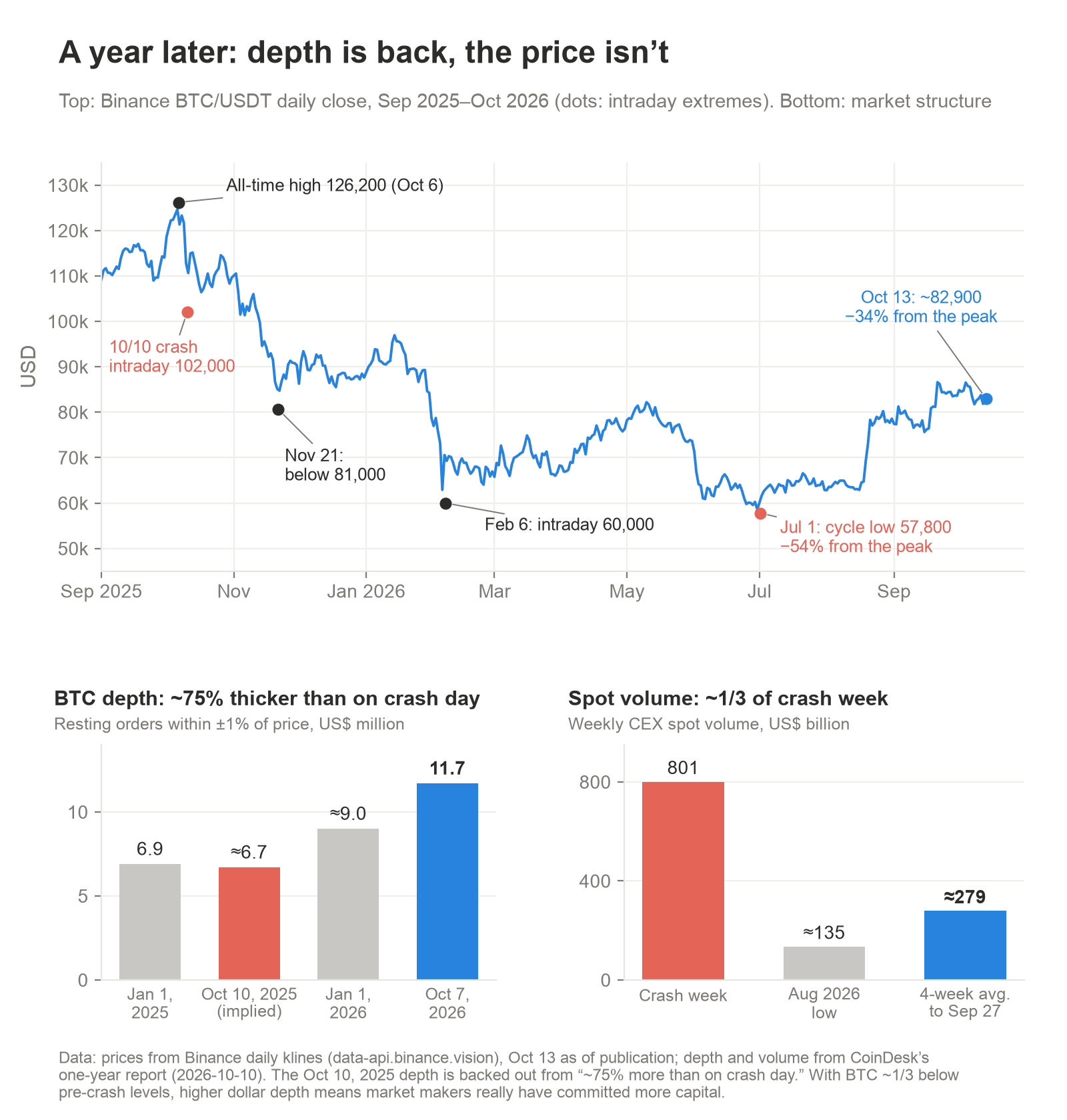
- 2026/10/13: BTC trades at about $82,900, still about 34% below its all-time high[38][39].
5.2 Market structure: what's fixed and what isn't
What's fixed:
- On October 7, BTC order-book depth within 1% of the price was about $11.7 million. That is about 75% more than on crash day and above the roughly $6.9 million at the start of 2025, even though BTC is about a third cheaper, so market-making capital has genuinely returned; it is not a price effect[9];
- ETH depth within 0.5% has doubled to about $4.2 million[9];
- Leverage has cooled: open interest as a share of market cap fell from 3.70% to 3.20% for BTC and from 11.30% to 10.40% for ETH, and funding rates have come down noticeably[40];
- Mechanism fixes: Binance switched the affected collateral to conversion-ratio pricing[24], and improved its transfer system[5]; Hyperliquid says it is still researching more refined ADL formulas[2].
What isn't:
- Depth within 5% for a basket of altcoins is about a third thinner than in early 2025, at only about $2 million[9];
- Trading is thin: weekly CEX spot volume averaged about $279 billion over the four weeks to September 27, only about a third of the crash week (~$801 billion), and fell as low as ~$135 billion in August[9];
- Total crypto market cap fell from about $4.28 trillion in early October 2025 to just over $2 trillion by the end of June 2026[2].
In other words,the plumbing for majors is wider than it was a year ago, while the plumbing for altcoins is narrower. When the next shock hits, the deepest wicks will most likely show up there again.
6. Lessons
For traders:
- Gaps plus a liquidity vacuum make stop-losses fail. Cut leverage proactively during thin-liquidity windows such as weekends, holidays and the hours after the US close.
- Know how your collateral is valued. USDT/USDC, USDe and LSTs may be valued under completely different rules on different platforms.
- A market stop is not insurance. When the order book is empty, a stop can fill far from its trigger price.
- Hedges can fail too. ADL may cut only your winning leg, instantly turning a neutral portfolio into one-sided exposure.
- Position spare margin in advance. In extreme markets, on-chain transfers are slow and expensive (gas topped 100 gwei that night), so don't count on moving top-up funds at the last minute. And don't keep all your assets on a single platform.
For platforms:
- Price pegged assets at their redemption value or conversion ratio, not off your own order book;
- Use multi-source indices with circuit breakers, filtering out extreme prints on a single book;
- Disclose liquidation data in real time and in full;
- Make ADL rules transparent and predictable, and publish the details of every trigger;
- Stress-test non-matching systems, such as transfers and balances, under extreme conditions.
For yield-bearing stablecoin and crypto card users:
- Stable on-chain does not mean stable on an exchange. If a product values your balance off an exchange's order book, your balance could be passively "marked down" in extreme markets.
- Check the conversion price source and the redemption channel. When the yield-bearing stablecoin in your card is spent or converted, what price does it settle at: the issuer's mint/redeem price, an on-chain pool, or some exchange's order book?
- Yield-bearing stablecoins are for saving, not for leveraged margin. Keep some USDT/USDC for everyday payments.
- Opacity is tail risk. Stream Finance's lesson: when the source of yield and the collateral structure are unclear, risk builds up where you can't see it[37].
In closing
10/10 was not a "black swan." The trigger came from the White House, but the explosives were piled up bit by bit by the industry itself: record leverage, liquidity that exists only in fair weather, rules that valued collateral off an exchange's own order book, and an ADL that cuts only the winners.
A year on, majors have deeper books and lower leverage, and both Binance and Hyperliquid have patched some of the holes exposed that night. But altcoin liquidity is thinner than before the crash, and the $19.1 billion single-day liquidation record still stands.
No one knows when the next macro shock will come. What is certain is that it will stress-test every mechanism once again. When it does, the question worth asking won't be "will prices fall?" but "have those holes been patched?"
Data and methodology
- Price data: Binance spot one-minute and daily klines (data-api.binance.vision); all times are Beijing time (UTC+8).
- Drawdowns: measured from the 04:50 open on October 11. The "deepest drop" is the lowest traded price between 04:50 and 07:59. Some extreme prices were single trades and do not reflect where most orders were filled.
- Total liquidations: CoinGlass snapshots taken at different times show $19.13 billion, $19.16 billion and $19.31 billion; the headline uses $19.1 billion. Because of feed throttling at Binance and other exchanges, the true figure may be higher.
- Fair value: for wBETH and BNSOL, estimated from the median of their price ratios to ETH and SOL in the hour before the event (about 1.079 and 1.075).
- Latest prices: October 13 prices are as of writing.
- Disclaimer: This article is a review of past events and does not constitute investment advice.
References
- The American Presidency Project: Truth Social Posts, October 10, 2025. https://www.presidency.ucsb.edu/documents/truth-social-posts-october-10-2025(opens in a new window)
- Datawallet: October 10 Crypto Crash Explained: Causes & Statistics (2026-09). https://www.datawallet.com/crypto/october-10-crypto-crash-explained(opens in a new window)
- CCN: 10 Biggest Crypto Liquidation Events of All Time. https://www.ccn.com/education/crypto/10-biggest-crypto-liquidation-events-all-time/(opens in a new window)
- WSJ: Stock Market Today (live coverage, 2025-10-10). https://www.wsj.com/livecoverage/stock-market-today-dow-sp-500-nasdaq-10-10-2025(opens in a new window)
- Binance Square: Full post-mortem of the Oct 10–11 market event (2026-01-30). https://www.binance.com/en/square/post/35795256795473(opens in a new window)
- Cointelegraph: Ethena founder on the USDe exchange depeg and oracle issues. https://cointelegraph.com/news/usde-depeg-oracle-issues-ethena-founder(opens in a new window)
- CoinDesk: No, Ethena's USDe Didn't De-Peg (2025-10-13). https://www.coindesk.com/markets/2025/10/13/no-ethena-s-usde-didn-t-de-peg(opens in a new window)
- Wu Blockchain: Hyperliquid Activates Cross-Margin Auto-Deleveraging for the First Time. https://wublock.substack.com/p/hyperliquid-activates-cross-margin(opens in a new window)
- CoinDesk: One year after 10/10, bitcoin and ether liquidity have rebuilt (2026-10-10). https://www.coindesk.com/markets/2026/10/10/one-year-after-10-10-bitcoin-and-ether-liquidity-have-rebuilt-but-other-altcoins-still-face-risks(opens in a new window)
- Yahoo Finance: Biggest crypto liquidation ever. https://finance.yahoo.com/news/biggest-crypto-liquidation-ever-sees-034631955.html(opens in a new window)
- 21st Century Business Herald (in Chinese): Crypto suffers an “epic crash” as single-day liquidations top $19 billion. https://www.21jingji.com/article/20251011/herald/46c331e53e4be18217224d93d96e5324.html(opens in a new window)
- PANews (in Chinese): A post-mortem of the 10·11 liquidation event. https://www.panewslab.com/zh/articles/9e47461f-fbf8-4f89-aaed-70f4e23004a7(opens in a new window)
- RockawayX: Crypto Market Update, October 2025. https://www.rockawayx.com/insights/crypto-market-update-october-2025(opens in a new window)
- Bitget News: The largest liquidation in crypto history: who lost the most?. https://www.bitget.com/news/detail/12560605010983(opens in a new window)
- CNN: China's rare-earth move and Trump's threats (2025-10-10). https://www.cnn.com/2025/10/10/politics/rare-earths-china-trump-threats(opens in a new window)
- Reuters: Trump says weighing massive increase in tariffs on Chinese imports (2025-10-10). https://www.reuters.com/world/china/trump-says-weighing-massive-increase-tariffs-chinese-imports-no-reason-meet-with-2025-10-10/(opens in a new window)
- Cointelegraph: Alleged Hyperliquid whale denies insider trading. https://cointelegraph.com/news/garrett-jin-whale-denies-allegations-shorting-bitcoin(opens in a new window)
- Reuters: Trump shaves China tariffs in deal with Xi (2025-10-30). https://www.reuters.com/world/china/looming-trump-xi-meeting-revives-hope-us-china-trade-truce-2025-10-29/(opens in a new window)
- Xinhua (English): Xi, Trump meet in Busan (2025-10-31). https://english.news.cn/20251031/224a622cd9254458a7c7a70cfcd37120/c.html(opens in a new window)
- FTI Consulting: Crypto Crash Oct 2025: Leverage Meets Liquidity. https://www.fticonsulting.com/insights/articles/crypto-crash-october-2025-leverage-met-liquidity(opens in a new window)
- DL News: Binance product helped cause crypto crash, says OKX boss. https://www.dlnews.com/articles/markets/binance-product-helped-cause-crypto-crash-says-okx-boss(opens in a new window)
- PANews (in Chinese): Market makers’ retreat and the ADL storm (Coinwatch data). https://www.panewslab.com/zh/articles/134ad2b2-44e2-4673-9915-6db858a89e88(opens in a new window)
- The Block: Wintermute's Evgeny Gaevoy says the market maker isn't suing Binance. https://www.theblock.co/post/377377/wintermutes-evgeny-gaevoy-says-the-market-maker-isnt-suing-binance-and-never-had-plans-to(opens in a new window)
- Binance announcement: Unified Account collateral pricing changes for wBETH, BNSOL and others (2025-10-06). https://www.binance.com/en/support/announcement/detail/d6deec042d784b6ba5d8710a8c69d79d(opens in a new window)
- Binance announcement: Compensation for USDe, BNSOL and wBETH price deviations. https://www.binance.com/en/support/announcement/detail/0989d6c7f32545bfb019e3249eaabc3f(opens in a new window)
- arXiv:2512.01112: Autodeleveraging: Impossibilities and Optimization. https://arxiv.org/html/2512.01112v2(opens in a new window)
- CoinGlass: 2025 Annual Report. https://www.coinglass.com/pt/learn/2025-annual-report-en(opens in a new window)
- CoinGecko: How Hyperliquid's HLP Vault Turns Market Chaos Into Profit. https://www.coingecko.com/learn/hyperliquid-hlp-vault-analysis(opens in a new window)
- Jeff Yan (Hyperliquid) on X (2025-10-11). https://x.com/chameleon_jeff/status/1977066751717429516(opens in a new window)
- Binance announcement: Statement on the October 11 market volatility. https://www.binance.com/en/support/announcement/detail/d9cb0d52d7c142a5be4f49732bd8760c(opens in a new window)
- Binance announcement: $400 million Together Initiative. https://www.binance.com/en/support/announcement/detail/3d45a1ab541f463982d59c8de85e36b8(opens in a new window)
- Forbes: Why The 10/10 Crypto Crash Still Haunts Bitcoin (2026-02-17). https://www.forbes.com/sites/greatspeculations/2026/02/17/why-the-1010-crypto-crash-still-haunts-bitcoin(opens in a new window)
- Bloomingbit: Whale Who Took US$150 Million Just Before Trump-Triggered Crash Denies Insider Trading. https://en.bloomingbit.io/feed/news/98721(opens in a new window)
- Cointelegraph: Crypto.com CEO calls for probe into exchanges after $20B liquidations. https://cointelegraph.com/news/crypto-com-ceo-regulatory-probe-exchanges-20b-liquidations(opens in a new window)
- CoinDesk: AAVE Sees 64% Flash Crash as DeFi Protocol Endures 'Largest Stress Test' (2025-10-11). https://www.coindesk.com/markets/2025/10/11/aave-sees-64-flash-crash-as-defi-protocol-endures-largest-stress-test(opens in a new window)
- CoinDesk: Stream Finance Faces $93M Loss, Launches Legal Investigation (2025-11-04). https://www.coindesk.com/markets/2025/11/04/stream-finance-faces-usd93-million-loss-launches-legal-investigation(opens in a new window)
- Pharos: Stream Finance: loss broke three stablecoins. https://pharos.watch/learn/case-studies/stream-elixir-contagion-2025(opens in a new window)
- CoinDesk: A year after its record high, bitcoin is down just 32% (2026-10-06). https://www.coindesk.com/markets/2026/10/06/from-retail-leverage-to-etf-flows-a-year-after-its-record-high-bitcoin-is-down-just-32(opens in a new window)
- Bloomberg: One Year After $19 Billion Crash, Crypto Faces a New Reality (2026-10-10). https://www.bloomberg.com/news/articles/2026-10-10/one-year-after-19-billion-crash-crypto-faces-a-new-reality(opens in a new window)
- CCN: Crypto October 10 Crash Anniversary 2026: Liquidation Risk. https://www.ccn.com/education/crypto/crypto-october-10-crash-anniversary-2026-liquidation-risk/(opens in a new window)